
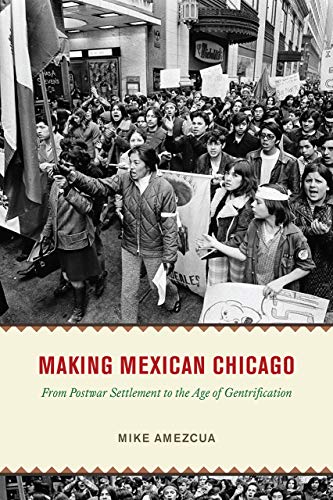
Making Mexican Chicago: from postwar sttlement to the age of gentrification
Material type: TextLanguage: English Publisher: Chicago, United States : The University of Chicago Press, Ltd., 2022Edition: 1a. edDescription: 337 páginas : figuras; ImpresoContent type:
 - texto
- no mediado
- volumen
- 978-0-226-82640-0
- 977.3 A514
| Item type | Current library | Shelving location | Call number | Status | Barcode | |
|---|---|---|---|---|---|---|
| Libro | Biblioteca Hernán Malo González | Biblioteca Central Bloque B | 977.3 A514 BG19898 (Browse shelf(Opens below)) | Available | BG19898 |
Browsing Biblioteca Hernán Malo González shelves, Shelving location: Biblioteca Central Bloque B Close shelf browser (Hides shelf browser)

|
No cover image available |

|

|

|
No cover image available |

|
||
| 973 S7986 BG19899 Latinos in the United States; What everyone needs to know | 973.7 D218 BG11259 Abrahan Lincoln | 973.92 B1114 BG13505 Closing of the american mind | 977.3 A514 BG19898 Making Mexican Chicago: from postwar sttlement to the age of gentrification | 980 A352 BG16841 Obra indigenista | 980 A472 BG18214 Bolívar, un espíritu universal | 980 B2715 BG12928 Pensamiento positivista latinoamericano |
Includes bibliographical references and index
Crafting capital. Deportation and demolition. From the jungle to las yardas. Making a brown bungalow belt. Renaissance and revolt. Flipping colonias. Conclusion. Acknowledgments. List of abbreviations.
Though Chicago is often popularly defined by its Polish, Black, and Irish populations, Cook County is home to the third-largest Mexican-American population in the United States. The story of Mexican immigration and integration into the city is one of complex political struggles, deeply entwined with issues of housing and neighborhood control. In Making Mexican Chicago, Mike Amezcua explores how the Windy City became a Latinx metropolis in the second half of the twentieth century.In the decades after World War II, working-class Chicago neighborhoods like Pilsen and Little Village became sites of upheaval and renewal as Mexican Americans attempted to build new communities in the face of white resistance that cast them as perpetual aliens. Amezcua charts the diverse strategies used by Mexican Chicagoans to fight the forces of segregation, economic predation, and gentrification, focusing on how unlikely combinations of social conservatism and real estate market savvy paved new paths for Latinx assimilation. Making Mexican Chicago offers a powerful multiracial history of Chicago that sheds new light on the origins and endurance of urban inequality.
There are no comments on this title.