
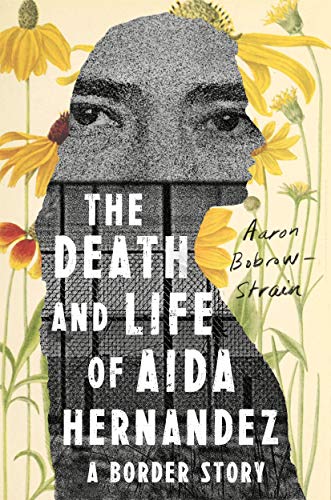
The death and life of Aida Hernandez: a border story
Material type: TextLanguage: English Publisher: New York, United States : Farrar, Straus and Goroux, 2019Edition: 1a. edDescription: viii, 416 páginas; ImpresoContent type:
 - texto
- no mediado
- volumen
- 978-0-374-19197-9
- 972 B6638
| Item type | Current library | Shelving location | Call number | Status | Barcode | |
|---|---|---|---|---|---|---|
| Libro | Biblioteca Hernán Malo González | Biblioteca Central Bloque B | 972 B6638 BG19901 (Browse shelf(Opens below)) | Available | BG19901 |
Includes bibliographical references
Prologue: The death of Aida Hernandez. No country for young women. Trauma red. Slipknot. Going awy to come back. Epilogue: The life of Aida Hernandez. About this book. Notes. Glossary. Explanation of terminology. Acknowledgments.
When Aida Hernandez was born in 1987 in Agua Prieta, Mexico, the nearby U.S. border was little more than a worn-down fence. Eight years later, Aida’s mother took her and her siblings to live in Douglas, Arizona. By then, the border had become one of the most heavily policed sites in America.Undocumented, Aida fought to make her way. She learned English, watched Friends, and, after having a baby at sixteen, dreamed of teaching dance and moving with her son to New York City. But life had other plans. Following a misstep that led to her deportation, Aida found herself in a Mexican city marked by violence, in a country that was not hers. To get back to the United States and reunite with her son, she embarked on a harrowing journey. The daughter of a rebel hero from the mountains of Chihuahua, Aida has a genius for survival―but returning to the United States was just the beginning of her quest.Taking us into detention centers, immigration courts, and the inner lives of Aida and other daring characters, The Death and Life of Aida Hernandez reveals the human consequences of militarizing what was once a more forgiving border. With emotional force and narrative suspense, Aaron Bobrow-Strain brings us into the heart of a violently unequal America. He also shows us that the heroes of our current immigration wars are less likely to be perfect paragons of virtue than complex, flawed human beings who deserve justice and empathy all the same.
There are no comments on this title.