
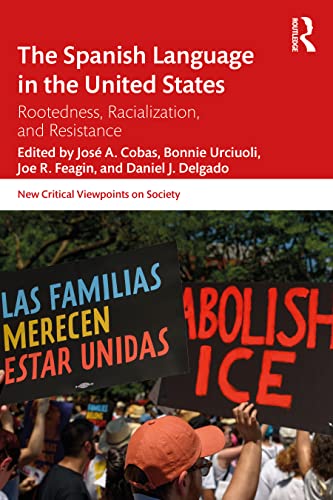
The spanish language in the United States: rootedness, racialization and resistance
Material type: TextLanguage: English Publisher: New York, United States : Routledge, 2022Edition: 1a. edDescription: xii, 162 páginas : figuras, tablas; ImpresoContent type:
 - texto
- no mediado
- volumen
- 978-1-03-219055-6
- 467.973 C6529
| Item type | Current library | Shelving location | Call number | Status | Barcode | |
|---|---|---|---|---|---|---|
| Libro | Biblioteca Hernán Malo González | Biblioteca Central Bloque A | 467.973 C6529 BG19585 (Browse shelf(Opens below)) | Available | BG19585 |
Includes bibliographical references and index
Section I. Language, Race, and Power. Introduction: Language, Racialization, and Power (Bonnie Urciuoli, José A. Cobas, Joe R. Feagin and Daniel J. Delgado). Chapter 1. Language Oppression and Resistance: The case of Middle-class Latinos in the United States (José A. Cobas and Joe R. Feagin). Section II: Rootedness: Chapter 2. The Early Political History of Spanish in the United States (Rosina Lozano); Chapter 3: The Demography of the Latino Spanish Speakers in the United States (Rogelio Sáenz and Daniel Mamani). Section III. Racialization: Chapter 4: What Anti-Spanish Prejudice Tells Us about Whiteness (Bonnie Urciuoli); Chapter 5: A Language-Elsewhere: A Friendlier Linguistic Terrorism (Mike Mena); Chapter 6: ´You Are Not Allowed to Speak Spanish! This Is an American Hospital!´: Puerto Rican Experiences with Domestic Discrimination (Alessandra Rosa, Elizabeth Aranda, and Hilary Dotson; Chapter 7: Blaqueamiento Dreams, Trigueño Myths, Refusal of Blackness (Michelle Ramos Pelicia and Sharon Elise). Section Four. Resistance: The Enchantment of Language Resistance in Puerto Rico (Kevin Alejandrez and Ana S.Q. Liberato); Subtracting Spanish and Forcing English: My Lived Experience in Texas Public Schools (José Angel Gutiérrez).
The Spanish Language in the United States addresses the rootedness of Spanish in the United States, its racialization, and Spanish speakers’ resistance against racialization. This novel approach challenges the ´foreigner´ status of Spanish and shows that racialization victims do not take their oppression meekly. It traces the rootedness of Spanish since the 1500s, when the Spanish empire began the settlement of the new land, till today, when 39 million U.S. Latinos speak Spanish at home. Authors show how whites categorize Spanish speaking in ways that denigrate the non-standard language habits of Spanish speakers—including in schools—highlighting ways of overcoming racism.
There are no comments on this title.